
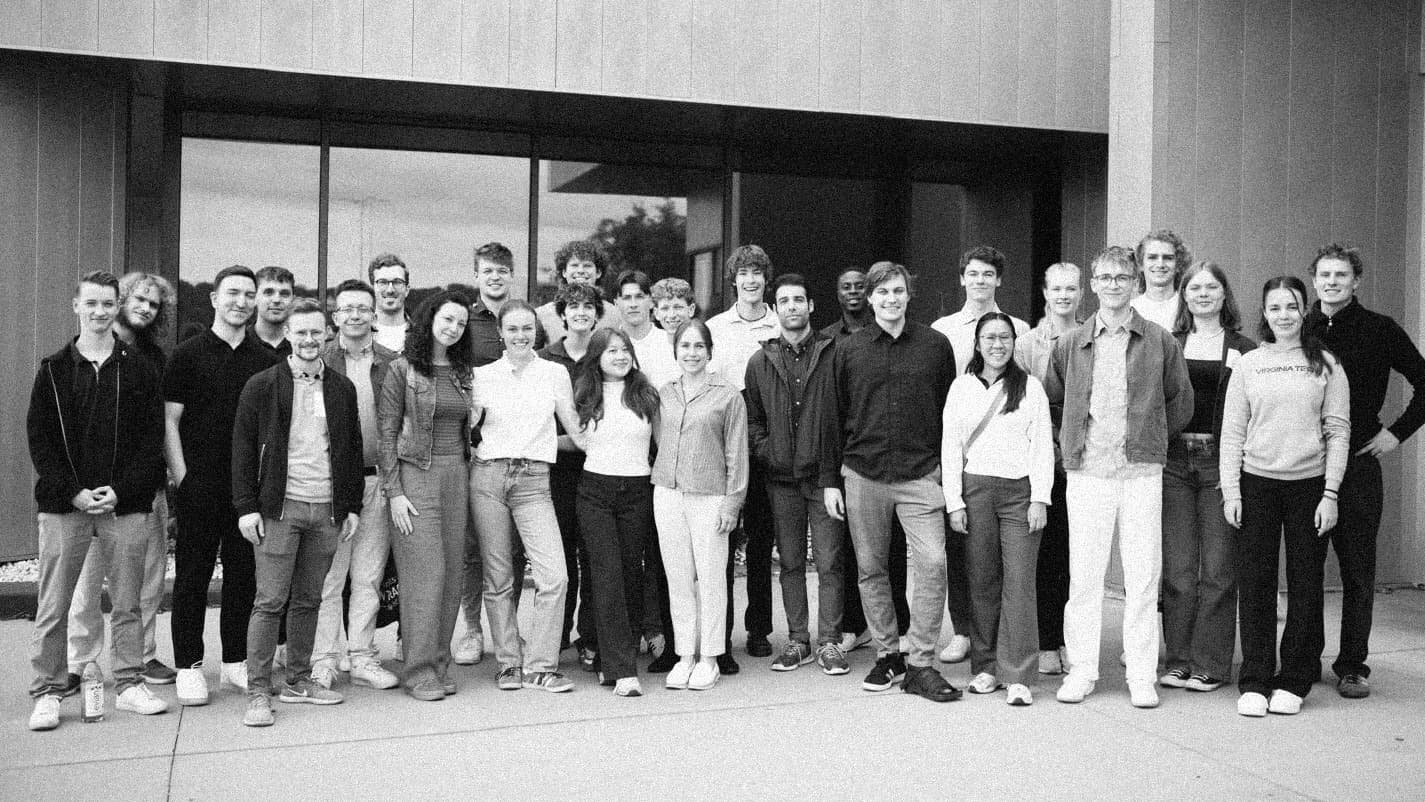
Fulbright's Leaders in Entrepreneurship at Virginia Tech
Most founders learn it too late: you can build the wrong thing flawlessly and still lose. I learned it this summer at Virginia Tech, working through Fulbright Germany's Leaders in Entrepreneurship Program with a small cohort of German engineers.
The structure was simple. Professor Christopher Courtney's[1] Foundations of Entrepreneurship was the spine. Guest lectures from founders and investors filled in the texture. The team project pulled us through the whole arc over three weeks - problem identification, user interviews, MVP scoping - each step pressing on the one before it.
Validate before you build.
Our team picked exam prep. The people grinding through the GMAT, MCAT, MSAT. A narrow niche on paper, until you start interviewing people who live inside it. The anxiety. The prep tools that promise structure and deliver homework. The slow erosion of confidence in the weeks before test day. Eleven conversations in, we knew what to build.
Resisting solution mode
The first phase kept us out of solution mode entirely. Just interviews, just synthesis, just clustering. The instinct, as engineers, is to start sketching architecture before you've even named the problem. Resisting that instinct is the actual skill the program teaches.
The lectures said the same thing in different accents. Seed founders, Series A operators, a couple of clean exits. You cannot validate a problem by asking someone whether they'd use your product. You validate by understanding what they already do without it.
Our project clicked when we stopped asking "would you use this?" and started asking "walk me through your last study session." The answers were specific, unflattering, and useful.
The cohort
No MBAs. No prior startup experience. Civil, mechanical, medical, software - engineers picking up entrepreneurship for the first time. Steeper curve, more honest learning.
The work didn't end when class did. Someone would bring up a confused point from lecture over dinner, and within ten minutes there were napkins out on the kitchen counter and laptops open between the plates. Nobody made us do that. We just wanted to figure it out.
The rest happened around the edges. Cooking classes that turned into mild arguments over cornbread. Trail runs in the Blue Ridge where the conversation drifted from German politics to which dining hall had the least dismal eggs. Pickleball games that started casual and turned ferociously competitive by the second week.
Beyond the classroom
Virginia Tech opened doors I didn't expect. We toured Volvo, Mack, and Torc - three different cuts at what "innovation at scale" actually looks like in person. Torc stuck with me: autonomous trucks, five-year roadmaps, capital requirements that don't fit on a slide. Different game from consumer software, same fundamentals.
The rest of the education was American campus life. Tailgating at Hokies football. A baseball game where none of us understood the rules and all of us stayed until the end. Hikes, dining halls, and the strange slow rhythm of a college town.
Our coordinators turned the logistics into something closer to hospitality. Alessandra Rosetti[2] and the Pamplin College of Business team made the program feel built around us. That's harder than it looks.
What I'm taking with me
Talk to users first. Eleven interviews before you scope a feature. Slow, and the only thing that works.
Learn next to people at your level. Working through frameworks with peers compresses months of solo reading into weeks.
Immersion teaches what a slide deck can't. You don't understand a startup ecosystem until you've lived in the culture that produced it.
Build enough structure to move. Leave enough slack for the tangents that turn into the real insights.
Let's go, Hokies! 🦃